
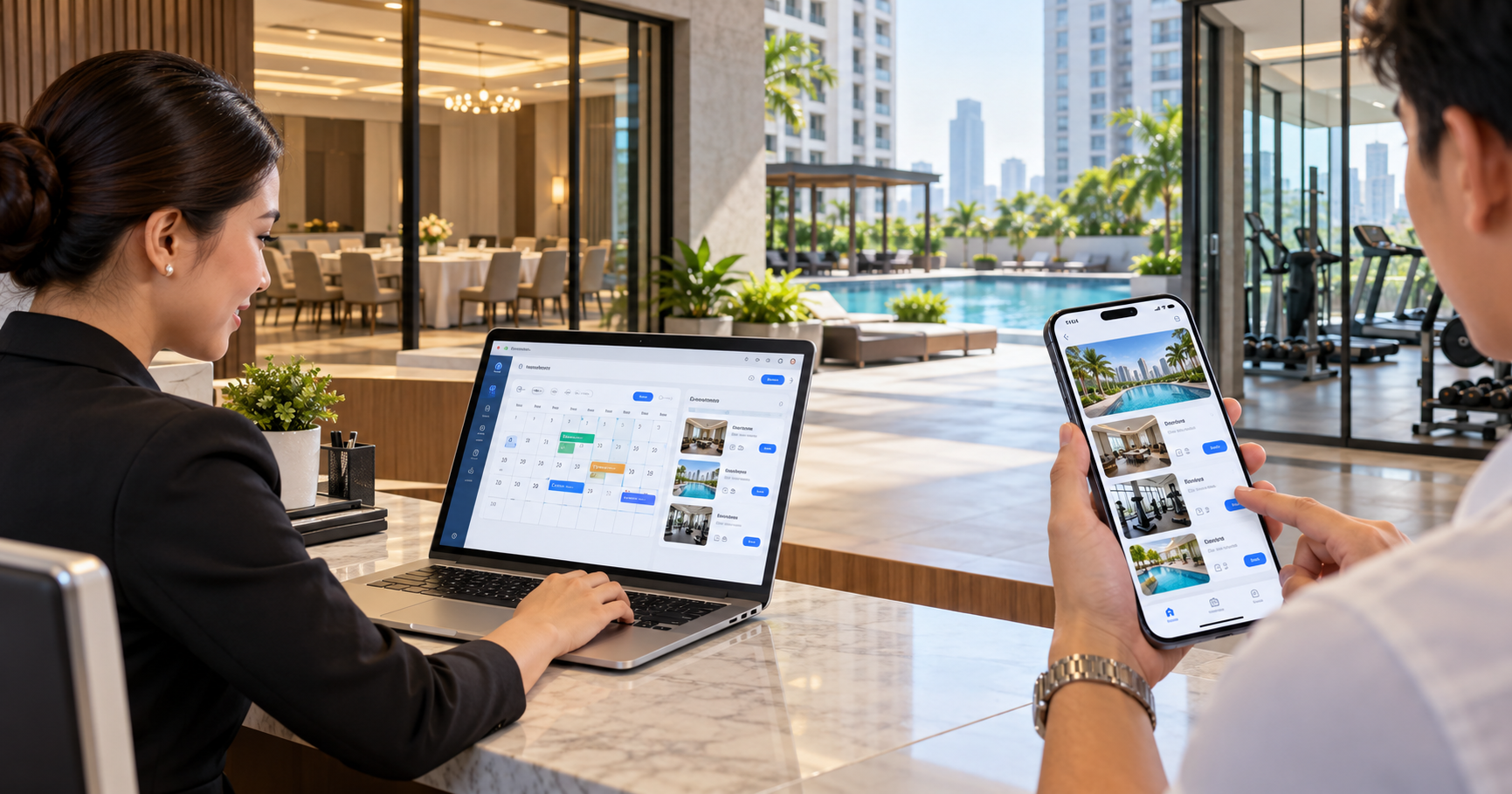
A resident requests the condominium function room for a Saturday gathering. Another household asks about the same time slot, but the property management office (PMO) knows the space needs cleaning before the next event. The problem isn't simply where to record reservations. Administrators must decide which requests qualify, what time is actually available, who can confirm a booking, and what residents should be told when plans change.
When comparing condo amenity booking software in the Philippines, focus on whether the proposed system supports your condominium's real facility rules and staff responsibilities. A booking screen alone does not guarantee fair scheduling, confirmed availability, or orderly use. The right approach is to test how people who manage shared spaces can review requests, schedules, restrictions, and decisions.
Why Does Amenity Booking Need Its Own Software Evaluation?
Amenities are shared resources with different purposes. A function room may need scheduled reservations and a turnover period. A tennis court may have hourly limits. A swimming pool may normally allow general access but occasionally close for maintenance or a private event, subject to condominium rules. Using the same booking process for every space can create unnecessary work or confusion.
Evaluate a digital amenity reservation system as part of a wider condominium management system, not as a substitute for property rules, maintenance coordination, or decisions by authorized personnel. The goal is to help administrators answer practical questions: Is this facility bookable? Who can request it? What does the proposed time cover? Has the property confirmed the request?
For a Philippine condominium, those answers should come from its applicable governing documents, authorized policies, and operating requirements. Software should align with the community's decisions rather than invent a universal reservation policy.
Which Condominium Amenities Actually Need Reservations?
Start with the facilities the PMO manages today. Do not assume the property needs a booking record for every common area. Some spaces are open for ordinary resident use, while others require controlled schedules because capacity, equipment, preparation, or shared access matters.
Facility example | Evaluation question |
|---|---|
Function room or clubhouse | Does the proposed process account for setup, event duration, cleaning, and the next booking? |
Sports court | How are requested time slots, session length, and property-imposed limits represented? |
Private meeting or activity room | Can the property distinguish ordinary use from exclusive reservation? |
Shared barbecue or event area | What information about permitted usage, operating hours, and approved occupancy is needed? |
Pool or gym, where reservations apply | How would authorized staff identify a scheduled closure or time-restricted activity? |
A condominium with several towers may also share one clubhouse or sports facility across buildings. Ask how the proposed setup would represent that arrangement, but do not assume any specific provider has a combined cross-tower calendar. The underlying question is whether staff can rely on a consistent view of the facilities they are responsible for.
How Should Software Represent Dates, Time Slots, and Availability?
Availability is more than a blank square on a calendar. Administrators may need to distinguish an open period from a requested period, a confirmed reservation, a blocked schedule, and time needed to prepare a facility. Those states should not be treated as interchangeable.
Imagine a function-room booking from 4:00 p.m. to 7:00 p.m. Does the requested time include preparation and cleanup? If another resident requests 7:00 p.m., does the property's policy allow immediate turnover? What happens if the PMO reserves part of the afternoon for maintenance? The important issue is whether the proposed software can represent the condominium's rules clearly enough for staff to make the correct decision.
During a demonstration, compare the time information shown to a resident with the information available to the authorized administrator. Ask the provider to show how dates and facility schedules are maintained, what a request means before approval, and how an unavailable period is handled. Do not assume real-time availability or automatic double-booking prevention unless those behaviors are demonstrated.
What Reservation Rules Should Administrators Evaluate?
A condominium may apply different reservation requirements based on the space, the requester's relationship to the unit, the event type, or the approved property policy. The software should be assessed against those existing requirements.
Questions worth bringing to a product evaluation include whether the property needs limits on reservation duration, advance-booking windows, maximum use per unit, permitted event size, or restrictions during maintenance. These are possible evaluation criteria, not mandatory policies for every condominium and not confirmed functions of every system.
Fairness matters particularly when a popular facility has limited slots. If two households request the same Saturday evening, staff should have a defensible basis for deciding which request can proceed. Ask how the system presents competing requests and relevant records to the authorized reviewer. Do not presume that software itself selects winners, enforces limits, or resolves disagreements.
Policies should also be communicated understandably. A resident needs enough information to decide whether a facility meets the intended use; the PMO needs access to any applicable conditions before confirming an event.
How Are Booking Requests Different From Confirmed Reservations?
This distinction deserves special attention. Submitting a request can start a review, not prove the resident is entitled to occupy the facility at the requested time.
When comparing systems, ask how residents and staff can distinguish a submitted request, one awaiting review, an approved reservation, a declined request, and a booking that has been canceled or changed. The exact status labels and workflow may differ by product. The condominium must decide which statuses it needs and who can make each decision.
Consider a resident who requests an event on Monday for Friday. If the event needs PMO review, the resident should not be led to believe the booking is final before a decision has been made. At the same time, staff should know what information is missing and which request needs attention. A well-designed evaluation checks both perspectives without assuming automatic approvals or notifications.
For broader request and approval workflows, explore our guide to property request management software.
What Happens When a Booking Changes or an Amenity Closes?
The real test of reservation management often comes in exceptions. A confirmed function-room event may need a revised time; a facility may close for cleaning, repairs, or a safety concern; an applicant may cancel; or staff may discover conflicting information in two reservation records.
Ask the provider to walk through a few realistic scenarios:
A resident requests a new time after the original reservation was confirmed.
The PMO closes an amenity for maintenance on a date with existing requests.
A weekend booking must be canceled under the property's applicable rules.
A resident asks whether a previously submitted request is still being reviewed.
For each situation, clarify who can make changes, which information should remain available for review, and how the property would communicate its decision. If a vendor claims automated messages, calendar conflict checks, or an audit history, ask to see the actual behavior and confirm what is included in the proposed configuration.
Software may support better organization, but it does not eliminate the need for responsible personnel to manage closures, exceptional requests, and disputes.
What Should Residents and Authorized Property Staff Be Able to See?
An amenity booking involves more than a facility name and date. A resident may need to see applicable usage conditions, the requested schedule, and the current status. PMO staff may need to review bookings, relevant unit details, restrictions, and facility preparation requirements. These are different information needs.
Condominium administrators should examine how access is limited to appropriate users. Could a resident inadvertently view another household's personal details? Do security or facility staff receive only the information they need to do their jobs? How are permissions updated when staff roles change? Those questions matter even if the booking record looks simple.
The Philippine Data Privacy Act of 2012 requires covered personal-information processing to follow principles including transparency, legitimate purpose, and proportionality. Property teams should collect and retain booking-related personal information only as appropriate for lawful, specified purposes and apply suitable safeguards. Purchasing software does not automatically establish privacy compliance.
For a wider discussion of owner- and tenant-facing property services, see our guide to a resident app for property management. For this article, the central question remains whether the condominium can manage amenity requests responsibly within its own facility policies.
Should Booking Fees, Deposits, and QR Codes Be Required Features?
Not every condominium charges for every facility. Depending on its approved policies, a function room may have a usage fee, a refundable deposit, both, or neither. Other facilities may be free for eligible residents. Start by reviewing the property's actual arrangements, not by assuming online payment is necessary.
If fees or deposits apply, ask the provider what information the system can display and record, whether payment handling is part of the proposed scope, and who remains responsible for confirming receipts or refunds. Never infer that a reservation module automatically collects funds, reconciles transactions, or applies deductions. Those are separate capabilities to verify.
Some property products also use QR codes or other electronic references for facility-related records. A displayed QR code should not be treated as automatic permission to enter or use a space. Ask what it represents, how it is checked, what happens if it cannot be scanned, and whether any physical access equipment or third-party connection is required.
What Should a Condo PMO Test During a Software Demonstration?
A demonstration should use your own anonymized facility scenarios instead of a generic menu tour. Bring one common amenity, one facility with limited capacity, and one booking that requires staff review. Then ask the provider to show the proposed setup from the perspectives of the appropriate resident and administrative teams.
Facility setup: How can the property represent the amenities it actually manages and the rules that apply to each one?
Schedule review: What does an available, requested, unavailable, or confirmed period look like to relevant users?
Competing requests: How would the PMO identify and evaluate two requests for the same period?
Staff decisions: Which actions are available to authorized reviewers, and which require a separate manual process?
Changes and closures: How does the system handle rescheduling, cancellations, and facility maintenance periods?
Permissions and privacy: What information can residents, administrators, and authorized facility personnel see?
Optional functions: Are charges, deposits, QR codes, reminders, or integrations included, configurable, or unavailable?
Implementation: What training, record preparation, account setup, support, or additional costs are required?
Request clarity about functions demonstrated live versus functions merely discussed as possibilities. Assess a product against the PMO's operational needs, budget, staff capacity, and agreed service scope—not the length of a promotional feature list.
How Does BahayKo Fit Into Condominium Amenity Services?
BahayKo provides a resident-facing Amenities feature that allows users to browse listed facilities and manage amenity reservation requests. The mobile interface supports submitting reservations for review, displaying pending requests, and viewing reservation notifications, details, and QR codes following administrator approval. Available facilities and reservation procedures depend on the property's approved setup and policies. Explore BahayKo's property management features to learn more about its resident services, accounting, maintenance, and security tools.
The presence of an amenity reservation area does not prove that BahayKo automatically prevents overlapping bookings, applies every facility rule, sends confirmations, processes fees, or authorizes entry through QR scanning. Properties should verify the specific interface behavior, available user roles, implementation arrangements, and any dependencies for their intended setup.
Bring your actual facility list, approved usage rules, and examples of a normal reservation and a scheduling conflict when you request a BahayKo system demonstration. Those examples will help your team determine whether the proposed configuration fits the condominium's needs.
How Should a Condominium Choose the Right Amenity Booking System?
The strongest choice is not necessarily the system advertising the most booking automation. It is the one that helps authorized teams understand facility schedules, evaluate requests consistently, communicate decisions, and manage changes under the property's approved rules.
When comparing condo amenity booking software in the Philippines, ask whether the system supports the facilities people really use, provides reliable information to the right users, and is practical for staff to maintain. Verify all important capabilities in the proposed configuration before adopting the platform.
Frequently Asked Questions
Does every condominium amenity need an online reservation?
No. Some facilities may remain available for general use under the property's rules, while others require scheduled reservations because of demand, capacity, or preparation. Evaluate software against the facilities that actually require controlled booking.
Does submitting an amenity booking request mean it is approved?
Not necessarily. Some properties require staff review or other conditions before confirming a reservation. Ask the software provider to demonstrate how a pending request differs from a confirmed booking in the proposed setup.
Can amenity booking software automatically prevent double bookings?
Some products may have conflict checks, but this should not be assumed for BahayKo or any other provider. Ask for a live demonstration using two requests for the same facility and time slot, including any administrator actions required.
Can condominium tenants reserve amenities, or only unit owners?
Eligibility depends on the condominium's governing documents, usage rules, and authorized account arrangements. A buyer should check whether the proposed system can reflect those distinctions without assuming the same permissions apply to every community.
Must amenity booking software include payments or security deposits?
No. Requirements depend on whether the property charges for facility use or maintains approved deposits. If payments are necessary, evaluate the proposed transaction process separately and verify fees, payment methods, records, and refund responsibilities.
Does an amenity QR code automatically allow facility access?
No. A QR code's meaning depends on the system and the property's verification procedures. It may represent a booking reference or another record, but the system must demonstrate automatic entry authorization and hardware integration rather than assuming them.
Disclaimer
This article offers general information about evaluating condominium amenity booking software in the Philippines. It is not legal, privacy, financial, security, or other professional advice. Facility policies, condominium governing documents, eligibility rules, fees, and software configurations vary. Property managers should verify product capabilities and, where appropriate, review their specific requirements with authorized decision-makers and qualified professionals.