
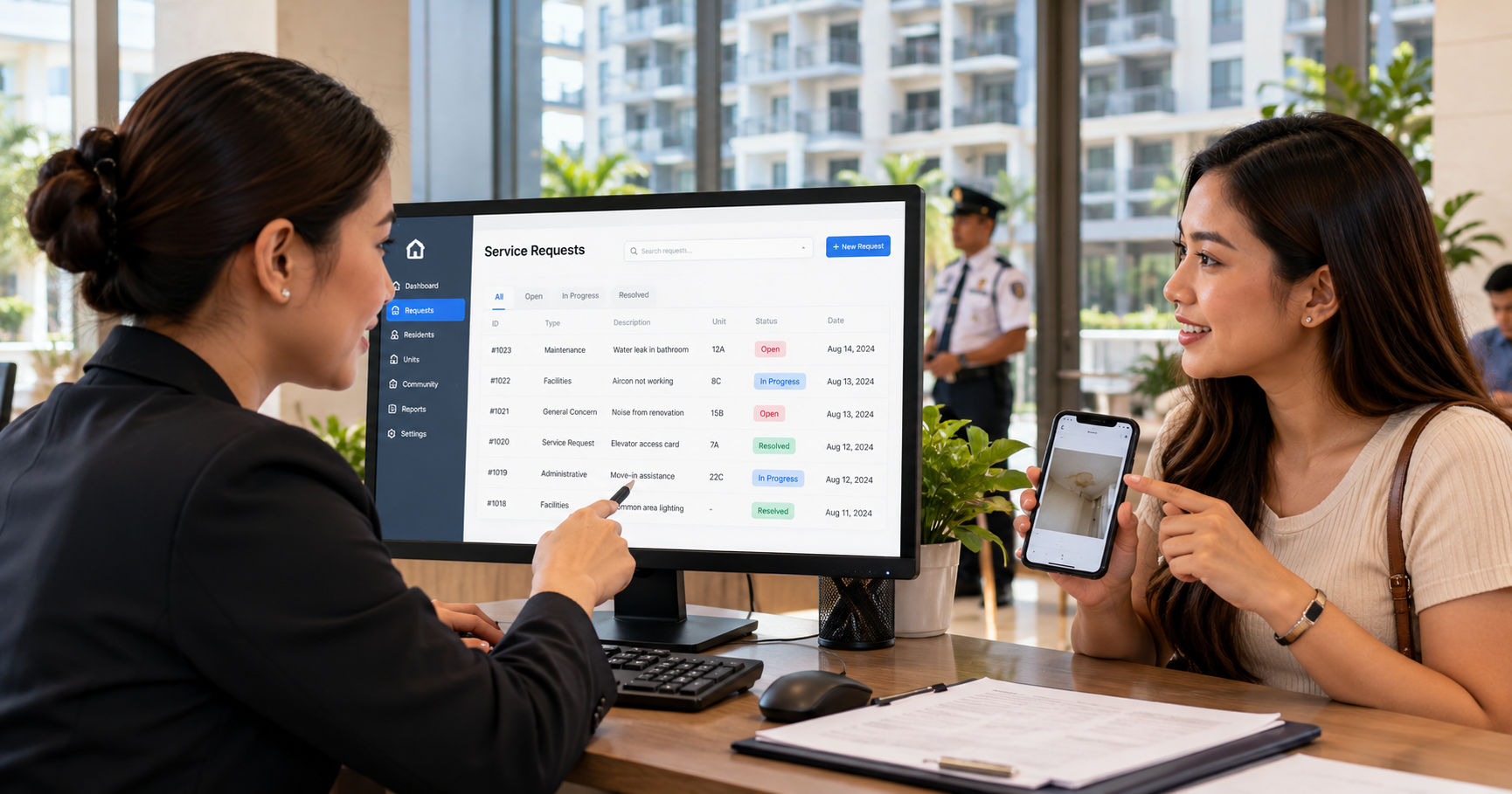
Property request management software helps property teams organize resident concerns, tenant service requests, and other reported issues so the appropriate people can review and follow them. For Philippine condominiums, apartments, commercial buildings, and industrial properties, the right solution depends on the requests received, staff responsibilities, information needed, and applicable property procedures. Evaluate how the software supports clear records and accountability before assuming it will automatically resolve complaints or speed up every response.
What Does Property Request Management Software Help Organize?
Requests can arrive through the front desk, phone, email, message thread, or a conversation with a security officer. A resident might report a recurring noise concern, while a commercial tenant might ask about a building service. Without an agreed way to record these matters, the same issue can be described differently across channels or passed between people without a clear point of reference.
A useful process helps authorized staff understand what was reported and who should review it. Software supports this work; it cannot replace property rules, staff judgment, or urgent direct communication.
Which Resident Concerns and Service Requests Should Be Distinguished?
One of the first questions is whether the organization can clearly distinguish the matters people report. Different categories may require different information and different responsible personnel. The categories themselves should reflect the property's services and approved operating procedures.
Request category | Illustrative situation | What property teams should evaluate |
|---|---|---|
Resident concern | A condominium occupant raises an issue affecting common-area use. | Whether the concern can be described accurately and reviewed by the appropriate personnel. |
Administrative inquiry | A tenant asks about a property document or office requirement. | Whether staff can distinguish an inquiry from an action requiring formal review. |
Service request | A resident requests an available property service. | Whether the request includes sufficient details to assess the requested service. |
Maintenance-related issue | An occupant reports a faulty fixture or possible building defect. | Whether the matter should enter a separate maintenance process. |
Access or permit question | A contractor asks about permission to perform work. | Whether the matter belongs under the property's gate pass or work permit procedures. |
These examples are not standard BahayKo categories. Properties may use different terms, and not every concern belongs in the same process.
What Information Makes a Property Request Useful?
A request record should help an authorized reviewer understand the issue without repeatedly asking the person to restate the basics. Property teams can evaluate whether their process captures an appropriate description, the relevant property location or unit (when needed), the type of concern, and the information needed for follow-up.
A reported issue is not always a confirmed diagnosis: a water stain, for example, does not establish which repair is needed. Distinguish residents' observations from later staff assessments.
Ask how users handle incomplete details, duplicates, corrections, and requests involving several areas. Collect sensitive descriptions or attachments only when necessary.
How Should Request Visibility and Accountability Be Evaluated?
A central issue in resident request management is knowing who is responsible for the next decision. An organization should identify who receives a concern, who can review it, who can provide updates, and who decides when the matter is addressed. These roles should be defined in policy and the service arrangement.
During a software evaluation, ask what an authorized user can see about an open request and how the organization would distinguish a new submission from one awaiting information or further action. Determine whether the proposed configuration supports the service request tracking and status information the property needs. Do not assume that every status change generates an alert, assigns a person, or triggers an escalation.
When staff can't resolve an issue immediately, they may need another party or further review. Accurate records are more valuable than unrealistic promises.
When Should a Concern Be Handled as a Maintenance Request?
Property issue reporting may reveal a possible repair need, but identifying an issue and carrying out technical work are different responsibilities. A resident may report a malfunction; the property team then decides whether to inspect the issue, arrange repairs, or take another appropriate response.
Confirm how a proposed system distinguishes general concerns from maintenance matters, who reviews the report, and whether separate technical records are needed.
Detailed work orders, technician assignments, task execution, and maintenance completion practices deserve their own evaluation. They should not be presented as automatic consequences of submitting a general concern.
How Do Request Management Needs Differ Across Property Types?
Condominiums, apartments, commercial buildings, and industrial sites may all need to handle requests, but the people involved and the rules governing them can differ substantially.
Condominiums: Resident concerns may involve common facilities, administration, service availability, or coordination with a property management office. Teams should assess how requests differ from matters that require association- or building-level decisions.
Apartments and residential properties: Tenant inquiries and service issues may need to be coordinated among the property manager, owner, and any external service provider. The right setup depends on the property's actual management arrangement.
Commercial buildings: Tenant organizations may communicate through designated representatives. A request process should take account of authorized contacts, shared facilities, and the boundary between routine service inquiries and contractual matters.
Industrial properties: Some reports may involve restricted areas, contractor requirements, operational disruption, or safety-related concerns. Software cannot replace site authorization, emergency response arrangements, or qualified technical assessment.
Properties need not share identical categories, access settings, or handling procedures.
What Privacy and Access Safeguards Should Property Teams Consider?
Service requests can contain names, contact details, unit information, photographs, or descriptions of private circumstances. In the Philippines, Republic Act No. 10173, the Data Privacy Act of 2012, and its Implementing Rules and Regulations provide the relevant legal framework for processing personal information. Principles such as transparency, legitimate purpose, and proportionality guide decisions about what data to collect and why.
Property teams should identify which staff genuinely require access, how residents or tenants are appropriately informed about data processing, and how records will be handled under applicable retention and security requirements. Consider whether users can distinguish their own request information from records intended for property administrators or other authorized roles.
Do not treat a software purchase as proof of compliance. The organization remains responsible for reviewing its policies, lawful basis for processing, safeguards, and any applicable obligations. Legal or privacy questions should be referred to qualified professionals when necessary.
What Should You Test During a Request-Management Software Demonstration?
Use realistic scenarios rather than judging a platform by how many screens it shows. Property teams can prepare sample situations without entering real residents' sensitive information into a demonstration environment.
A straightforward inquiry: How would authorized staff identify the request and decide whether to respond or take further action?
An incomplete concern: What options exist when a submission lacks enough information?
Two reports about the same issue: How can the property recognize related matters without assuming that records are merged automatically?
A maintenance-related report: Where would the property distinguish a concern from a task requiring technical assessment?
A request awaiting another party: How would the team represent the situation accurately without promising an unsupported completion time?
Restricted information: Which authorized roles can view relevant details, and what must be confirmed about permissions?
Ask what is included, what requires configuration or additional services, and what training is needed. Compare demonstrations against documented requirements.
Which Property Request and Resident Concern Features Does BahayKo Support?
BahayKo supports several property service functions that help residents communicate concerns and submit requests while giving authorized personnel a more organized way to work with the related information. These functions include resident concerns, job requests, job orders, and maintenance services. Each serves a different operational purpose, so property teams should assess how they fit existing responsibilities and policies.
Resident Concern Submission and Records
Residents can submit concerns through BahayKo and refer to the related details. This gives residents a defined place to communicate a property issue, whether it involves a common-area concern, a service question, or another matter that needs the attention of appropriate personnel.
For property administrators, maintaining a clear concern record can make it easier to understand what was reported. A digital submission does not guarantee immediate action or resolution; a responsible team still needs to review the matter and determine the appropriate response.
Concern Types and Organized Follow-Up
BahayKo supports concern types to help property teams distinguish different kinds of reported issues. Categorization can make records easier to review and helps staff recognize when a matter may call for administrative attention, security coordination, or maintenance support.
The categories and response rules should reflect the property's actual services. A resident concern is not automatically the same thing as a maintenance task, and sensitive information should be accessible only to the personnel who need it.
Job Request Management
BahayKo includes job request functions for property-related work. Residents can provide relevant request information and use supported submission functions, while authorized property personnel can review requests according to their responsibilities.
This can help distinguish a request for work from a general inquiry or concern. The property remains responsible for deciding which requests require approval, what supporting information is needed, and what action is appropriate.
Job Order Support for Property Operations
BahayKo also provides job order functions for organizing property service activities. Job requests and job orders address related but distinct parts of property work, and teams should understand the difference when evaluating the platform.
The presence of both functions does not mean every request automatically becomes a job order or that personnel and materials are assigned without review. The exact arrangements depend on the property's operating requirements and implementation.
Maintenance Service Requests
Residents can use BahayKo's maintenance-related services to communicate a service need. The platform also includes maintenance functions for personnel responsible for property upkeep, supporting coordination around relevant service information and work updates.
For example, a reported issue that requires repair may need more than a general concern record. Property teams should decide which cases belong in their maintenance process and which require a different form of follow-up. Emergency situations still require the property's established urgent-response procedures.
Request Details, Notifications, and Status Visibility
BahayKo provides access to relevant details and notifications for supported concern, job request, and maintenance functions. This can help residents and authorized personnel refer to request information instead of depending entirely on separate messages or repeated verbal follow-ups.
Available statuses and notifications should be evaluated for each function and user role. Digital visibility can support communication, but it should not be presented as automatic assignment, guaranteed response times, or completion of the requested work.
What Should Property Managers Evaluate?
Before introducing a digital request process, identify who handles resident concerns, who can approve work-related requests, when an issue becomes a maintenance matter, and what information each team is permitted to view. These distinctions matter for condominiums, apartments, residential communities, and commercial or industrial properties with different service arrangements.
Review BahayKo's property management features or request a BahayKo system demonstration using realistic examples from your property. The goal is to assess how supported functions fit your team's responsibilities, not to assume that every service request follows the same process.
How Can a Property Choose a Suitable Request-Management Approach?
Start by identifying the concerns and inquiries that repeatedly confuse staff, leave records incomplete, or create unclear follow-up. Define who needs information, what decisions they own, and which matters belong to separate maintenance, security, or approval processes. Then assess whether a proposed system supports those needs in a form property staff can actually use.
The value of property request management software is not measured by category counts or promises of instant action. An effective approach helps an organization maintain clearer records, define responsibilities, and communicate realistic next steps while respecting its operational limits and privacy obligations.
Frequently Asked Questions
What is property request management software?
It is software that supports recording, reviewing, and managing property-related concerns or service requests. Capabilities and workflows depend on the product and the property's approved procedures.
Is resident concern tracking the same as maintenance management?
No. Resident concern tracking addresses a wider range of reported issues. Maintenance management concerns technical service activities and work that may require separate assessment, authorization, personnel, and records.
Can a small apartment building use a manual request log?
Yes. A properly managed manual log may be suitable when request volume is manageable, responsibilities are clear, and personal information is protected appropriately. Digital software should address a defined operational need.
Does tenant service request software automatically assign every concern?
Not necessarily. Assignment and escalation behavior differ by product and configuration. Ask the provider to demonstrate the exact process instead of assuming that submission creates an automatic staff assignment.
Should commercial and residential properties use the same request categories?
Not automatically. Categories should reflect each property's occupants, services, authorized roles, contractual arrangements, and operating procedures.
Does digital request tracking guarantee faster resolution or privacy compliance?
No. A software system cannot guarantee response times or legal compliance. Property policies, personnel, service arrangements, appropriate safeguards, and the actual implementation remain important.
Disclaimer
This article provides general information on evaluating software for property requests in the Philippines. It is not legal, privacy, safety, or professional operational advice. Software suitability and availability depend on the property, provider, configuration, and applicable rules. Confirm product behavior for your intended setup, and seek qualified professional guidance when needed.